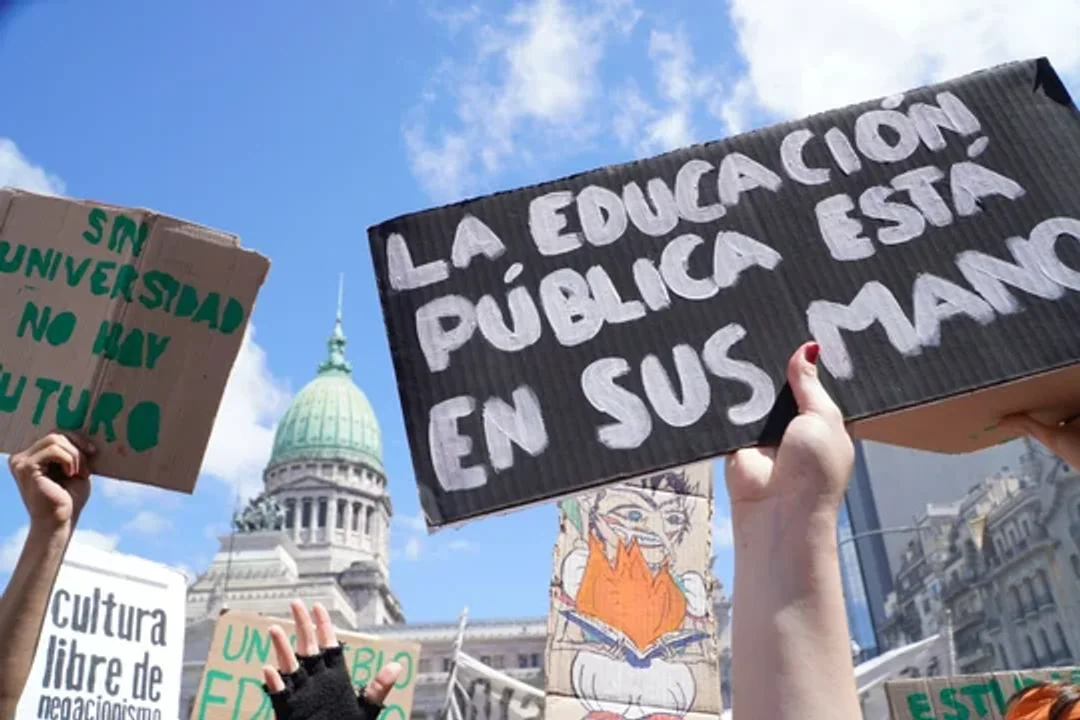
The conflict not only pits the unions against the Casa Rosada over budget restructuring; it also revives the fight over the so-called 'university funds', a universe where resources for salaries, operations, infrastructure, institutes, hospitals, research, and administrative structures with strong political weight coexist. In the same vein, the sector demands the full application of the law passed by Congress, which obliges the State to adjust teacher and non-teaching salaries, update operating budgets, scholarships, university hospitals, and science and technology areas, with a cost estimated by the Congressional Budget Office at around 0.23% of GDP. But behind the salary demands lies a deeper debate: who controls, administers, and audits the funds of the university system. For many, this is another strike that punishes Argentines, disrupts the academic calendar, and also functions as a pressure tool to defend entrenched privileges in the management of university funds. The picture is a familiar one: empty classrooms, disrupted schedules, and students forced to reorganize their courses, exams, and commutes amid a tug-of-war that has been dragging on for months. The central argument of the unions is salary-based. AGD UBA states that the real salary of teachers is 35.6% below that of November 2023 and up to 2.7% below the worst levels recorded in 2004. The measure impacts the start and continuity of classes in much of the public system and once again leaves thousands of students as the main hostages of a fight that, once again, harms Argentines. The protest has a national reach and adds significant support. In the middle are the students, their families, and taxpayers, who once again bear the cost of a dispute that can no longer be explained by inflation alone or university autonomy alone. The National Interuniversity Council had warned of a crisis risk in 2026, while the ruling party and the university system still have not found a stable solution. In the case of UTN, the protest affects its 30 regional faculties and the National Higher Technical Teacher Training Institute, while in some institutions, the action lasts 24 hours, and in others, it extends for almost the entire week. According to data cited in various reports and in the budgetary discussion itself, around 90% of the university budget is concentrated on salaries and basic operations, leaving little room for infrastructure, research, and expansion. The debate over audits and control of these funds has returned to the forefront in recent months, following the controversy over the role of the AGN and SIGEN in the oversight of national universities. Participation was confirmed by teachers from the University of Buenos Aires, the National University of Córdoba, the National University of La Plata, the National Technological University, the National University of Rosario, the National University of Tucumán, the National University of the Northeast, the National University of Chaco Austral, the National University of Salta, the National University of Entre Ríos, and the National University of José C. Paz, among others. The general secretary of the union, Laura Carboni, also stated that since November 2023, they have lost the equivalent of 11.5 salaries and denounced that, in fact, 'for every three months worked, they only paid for two'. In parallel, teachers grouped in the University of Buenos Aires Teachers' Association (AGD UBA) went even further and voted for an 'indefinite' strike until the salary adjustment is paid, which, according to them, arises from University Financing Law No. 27.795. In this context, the strike again leaves the feeling that, beyond the genuine claim for income, a battle is also being fought to preserve areas of power and resource management that few are willing to cede. The general picture also shows a tension that goes beyond the unions. Buenos Aires - March 16, 2026 - Total News Agency - TNA. This Monday, a new national strike began in public universities across the country, a measure driven by the Conadu and Conadu Histórica federations, which decided on a two-stage work stoppage: from March 16 to 21 and then from March 23 to 30.